Breadth of Work
Behold my everything else. My kitchen sink. My “check this page out, it’s worth it.”
Huy Fung Sriracha
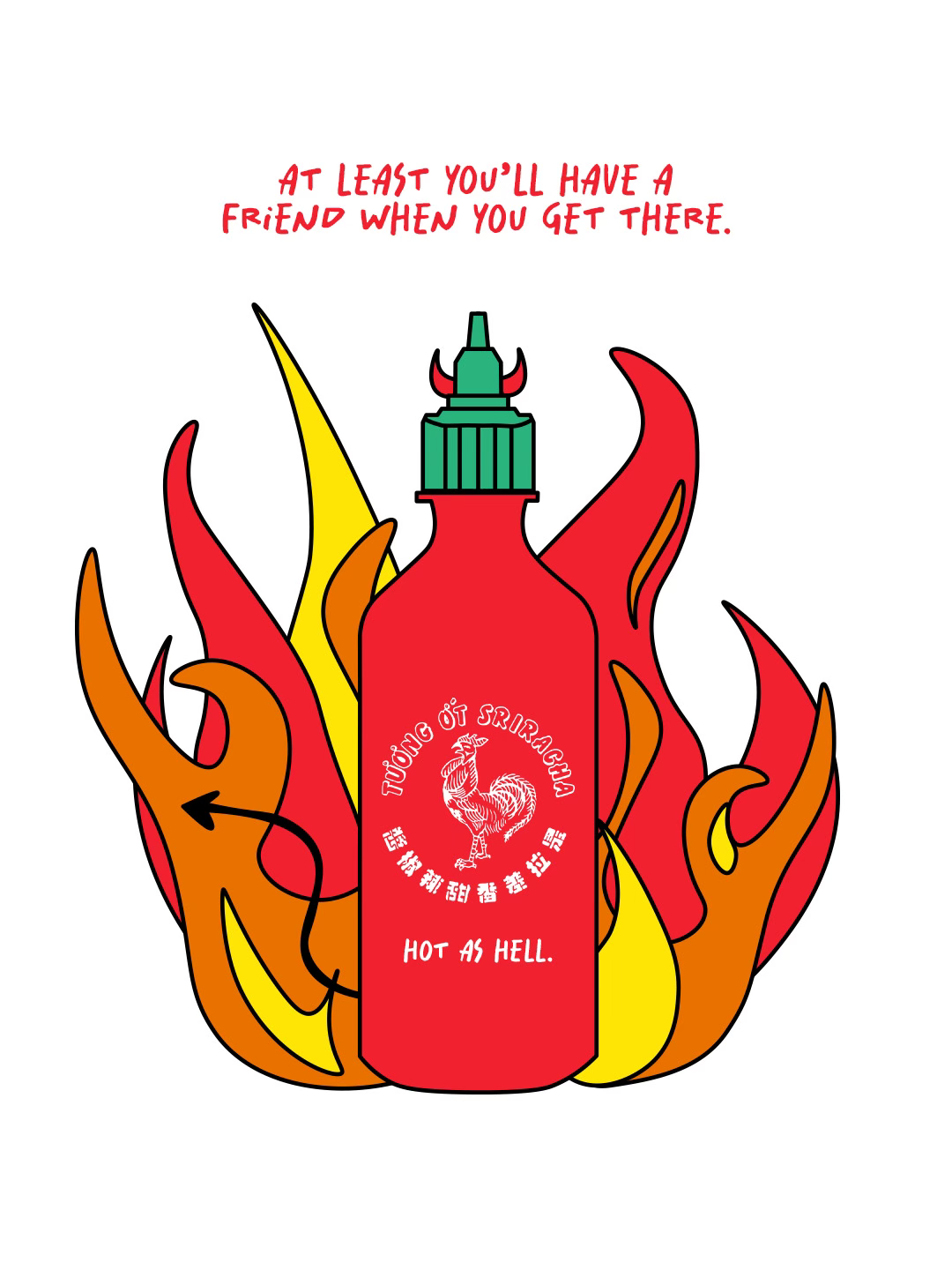
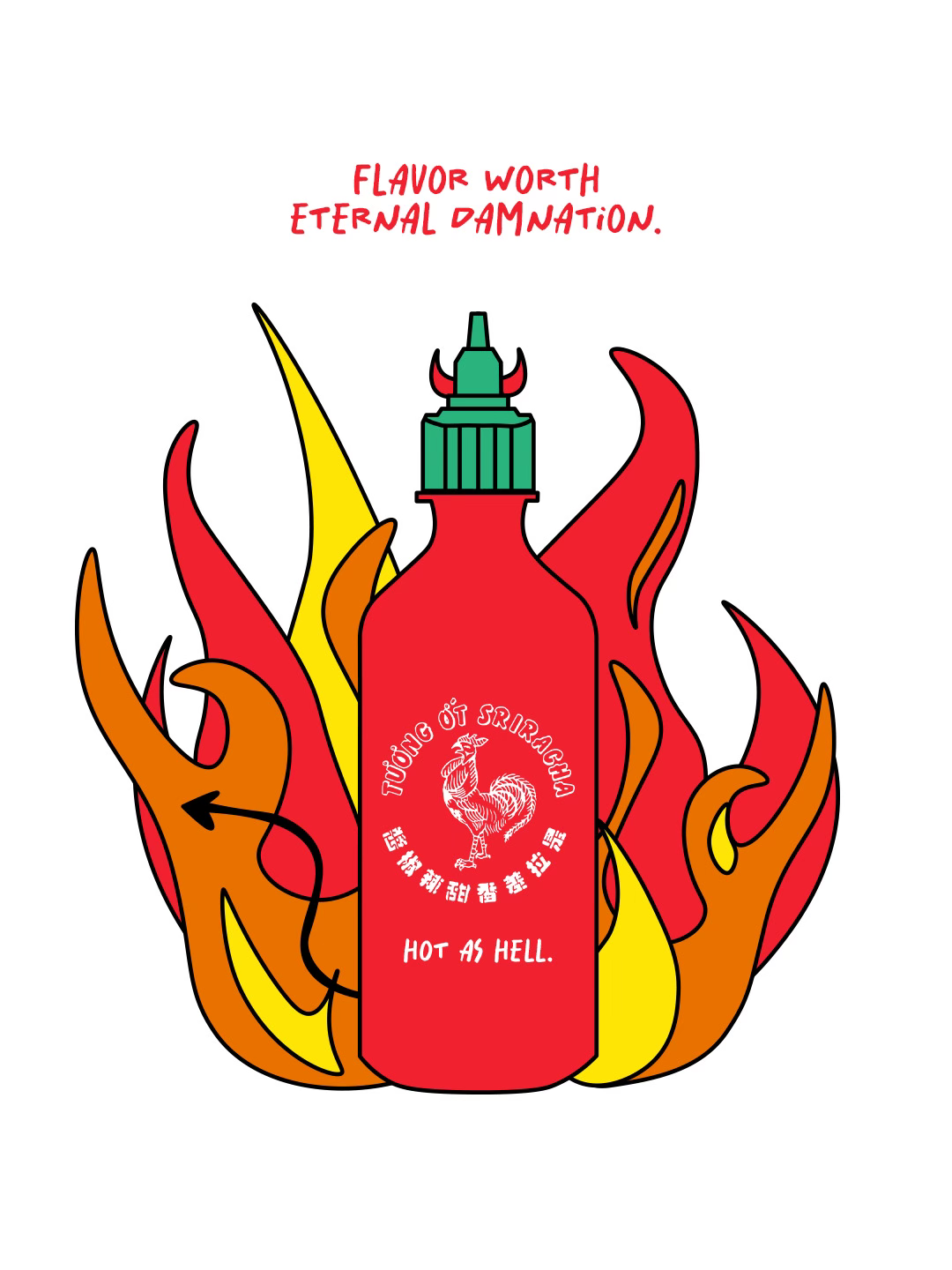
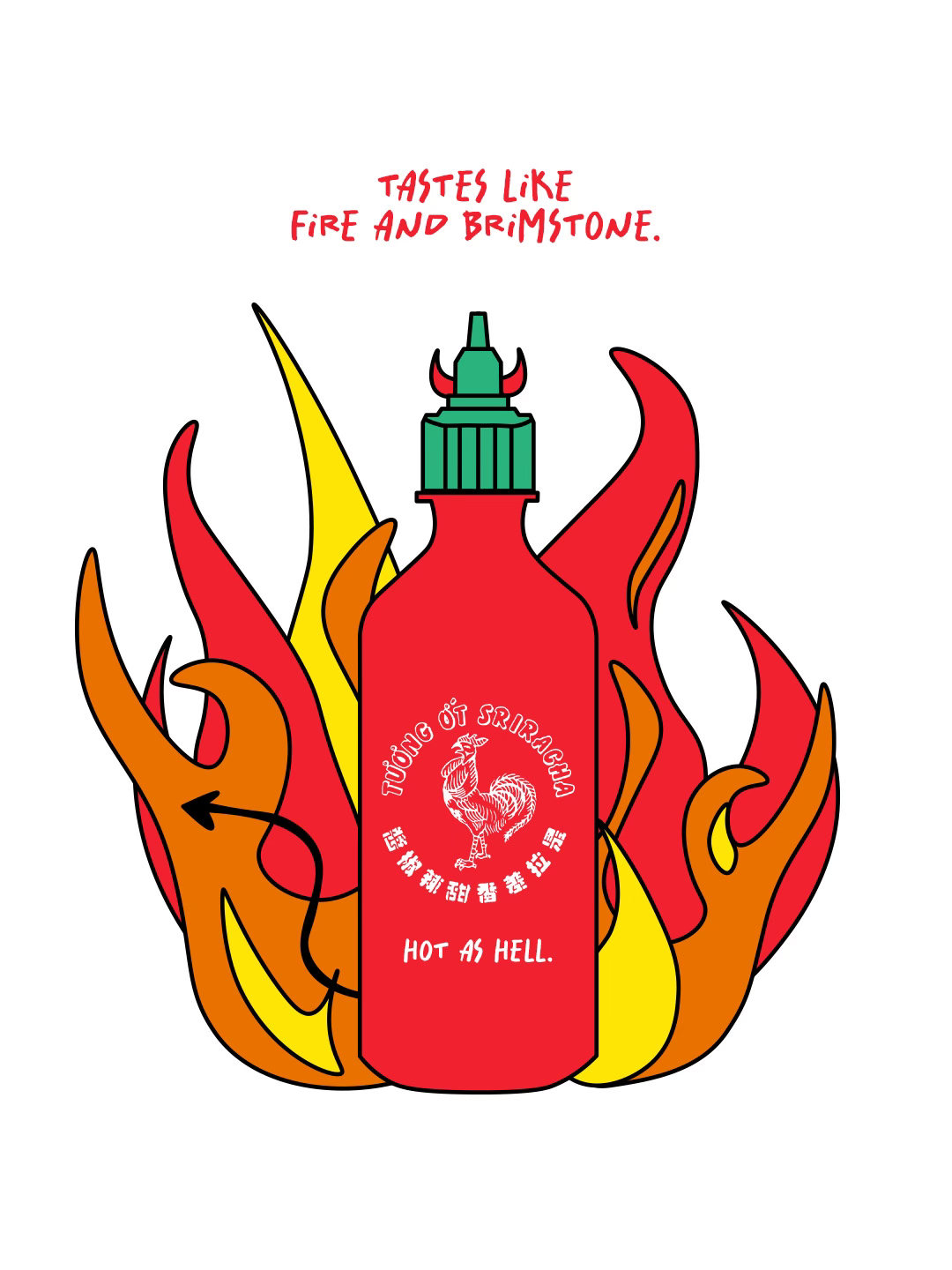
When you think hot, you think sriracha. This campaign combines the flavor of everyone’s favorite hot sauce with everyone’s least favorite afterlife option.
Art Director: Calista Martin
Creative Writing
Sometimes I feel emotions. Sometimes I write about them.
Impulse Purchases and Commitment Issues
On my long bank statement from our family vacation to Yosemite National Park, the four stickers I bought in the gift shop barely made a blip in my expenses. Each one was only about three dollars, including tax—a total of twelve for a handful of silly vinyl reminders. They were on display next to the cash register, nestled in between pricey trail mix and protein bars. (Note the lack of impulse-buy candy. This was Yosemite, after all.) I picked them out and laid them on top of the sweatshirts and jackets I was already buying. After paying, the receipt spit out evidence of over a hundred dollars spent.
I bought more trinkets and souvenirs throughout the trip—victim of both bandwagoning and aesthetics—but none as easily as those stickers, the measly twelve dollars hardly a thought. When I unpacked my suitcase, I pulled the stickers out of a side pocket and put them on top of my dresser, in plain view to decide where to use the new decorations. Despite everything I bought, those stickers were my favorite. And it was my favorite family vacation we’ve ever had. There was something magical about free reign of forests and rock formations—and gift shops.
Eventually, the stickers moved from the pile on my dresser to a shelf in my closet. And then to a junk drawer. And then to the black hole of my house. I haven’t seen them in years. I still think about that vacation.
—
I usually didn’t buy souvenirs in Ventura because there was nothing special about visiting it. Not to say it wasn’t a great place—I loved every time we visited Ventura because it was so familiar. I lived there for maybe three months as a newborn before we moved. Too young and too brief to make a connection. Maybe I imagined the deep fondness I felt for that city, but it was never a place that required a reminder, because I was always going to come back.
One day, though, my dad was in Ventura Surf Shop, his favorite place to rent boards, and I had decided to come with this time. I walked up and down the store aisles while he talked to the cashier. By the end, not a single sweatshirt cuff went untouched by my bored fingers.
As my dad signed the rental agreement, I made my way to his side, staring at the enormous wall of surfboards behind the employee. They were shiny, just-waxed, but what caught my eye was the lazily spinning display of stickers. I couldn’t surf, but I thought the bright surfboard doodles were cute anyway. Might as well show that I had been to one of the coolest places in California. While I snagged four and the cashier rang them up, I could taste salt on my tongue from the ocean just a mile away. The ocean I could barely even boogie board in.
The stickers started in a Ventura’s Surf Shop bag, floated around the general vicinity of my bedroom, and ended up somewhere they were never used. It wasn’t like I needed a reminder of Ventura, anyway.
—
I was going to put the Yosemite stickers on important places. There were plenty of half-used notebooks and well-dinged water bottles that could have called them home, so a shortage of empty space to fill wasn’t the problem. Every time I got close to peeling the backs off and marking something permanently, I was reminded of the memories I made there. I listened to my brother, an amateur rock climber, spew fun facts about Alex Honnold on our way to see El Capitan. And when a different brother ran straight for the sheer cliff drop to get a better view of Half Dome Rock, we all yelled at him to tie his shoelaces first.
I saw plenty of other people with laptops and binders covered in vacation stickers. What would they think if they saw mine? Would they know how much Yosemite actually meant to me? Did it even mean much at all?
—
I was going to put the Ventura stickers on important places. There were plenty of folders and sketchbooks that would have welcomed the decorations. Every time I gathered the courage to make a decision, I thought about how people would see my proud declaration of Ventura on my things. Would they think I was a California native, who actually got to know the city she was born in? Would they think I was a surfer who knew all the best ways to drop into a wave? Would they think I was tricking them if I confessed I actually couldn’t surf at all?
—
There is too much personality screaming from things covered in stickers. They yell who I am; they yell it with permanence. There’s no taking it off unless I want to scrape the little sticky bits off with my fingernails. There’s too much assumed at one glance, too many misconceptions people could make about me, what I like or dislike, who I am as a person. I think I’ve realized that stickers are easy to buy but hard to own. Purchasing one doesn’t mean anything until it’s time to commit.
It’s silly. It’s just a sticker.
Mental Construction
I was seventeen years old (an age which I still think I am), sitting at the kitchen counter, a sweaty grip on my favorite pen as I stared down the vast expanse of white, blue, and red. What’s white and blue and red all over? An empty notebook paper. Typically I would have been writing using the family computer, but my mom recommended I stick to good old pen and paper for something this important. I ran through my typical lame fun fact roster—which were usually the inversions of what people would share as their fun facts: I can’t whistle, I can’t make a taco with my tongue, I can’t wiggle my ears. In the more college application-esque variety, I never went on any life-changing humanitarian trips, started my own business at age eleven, or volunteered at a local animal shelter every weekday for four years. In short, I wasn’t qualified to go to college, much less write five essays arguing why they should let me in.
While I thought myself into a ditch, the kitchen was quiet except for the buzz of the refrigerator. It felt a little too silent for the important work stewing in my mind. Running through all of my childhood memories, my middle school epiphanies, my teenage opinions, I found the top of the pen and began to press. The lightest tap with my thumb made a captivating noise. Click. Click. Click.
—
Thinking was all I seemed to do lately. In the basement of the campus library, I thought about how I was trying to change my thinking at college. I thought about how my thinking was going in circles. I thought about this ten page paper I had to write, and my skin crawled like someone was drawing on it with a pen. In my humanities class, I was assigned to write about the construction of a Gothic cathedral in France, and I was frozen, because this was the first college-sized paper I would ever write. There’s something different about writing papers in high school, because there’s nothing really at risk besides your grade. Here, surrounded by other students, it felt like there was much more at risk. In ten digital pages, twelve-point font and double-spaced, I had to prove that I belonged here.
But I wanted to prove it in blue ink first. I tapped my pen against the side of the table, trying to brainstorm an argument about this cathedral that no one had ever made before. Since it was over 800 years old, that was a tall ask from my professor. So many things floated through my mind—the unique rose stained glass windows, the statues of apostles above the entrances, the motif of squaring the circle. I built and tore down arguments in my head, reconstructing the introduction with each new thesis mentally drafted. The body paragraphs would change tone, the conclusion had to be moved to the left, but nothing was concrete—nothing on the page, yet.
The library was quiet, and I started clicking my pen. My hand twitched like a writer possessed, but it pressed thumb to pen, not pen to page. The click-click-click in the quiet steered me no closer to an epiphany, but it was helpful all the same. And so the clicking continued, despite multiple dirty looks and pointed sighs. In the absence of splitting open my skull to show my brain hard at work, I settled for clicking my pen. It got the point across well enough.
—
The pen is always compared to the sword, but I propose a new pairing: the pen and the hammer.
It’s easy to believe there is nothing happening in silence. Construction zones are full of screeching, rattling, and beeping. The building of a new wall happens so slowly that you might not realize what has changed each day, but the noise proves the work. Drills, saws, and hammers create a cacophony so dizzying that there’s nothing to conclude besides change happening—if not in front of your eyes, then your ears.
My mind is a different kind of construction zone when I’m trying to write. There are intangible orange cones and roadblocks and blinking signs. There’s no proof that my gears are spinning until words are on the page. I could think for hours, with dirt, dust, and debris, but there’s no finished house on the horizon. Progress only feels real when there’s physical proof. And in moments where the quiet seems like failure, seems like nothing happening, I click my pen so the world knows I am hammering away. A blank page won’t stay blank forever as long as my pen makes a sound.
Freshman
He misses his sister more than a simile loves a cliche / More than amateurs love run-on sentences / More than artists love breaking the rules / Did you know there are 1,062 cinder blocks in his new apartment? / Because he does / He counts them / start to finish / when he can’t think about a cross-county road trip / expired vending machine snacks / mislabeled boxes / or keys changing hands / He has texted his sister each time the fire alarm goes off / Did you know there are seven / so far / wrong ways to make Mom’s chili? / He should stick to microwave mac and cheese / His head is always hurting because of / a laptop screen in the dark / a professor with impossible instructions / the empty ibuprofen bottle she told him he needed more of / Apparently cold water and laundry detergent / he forgot to buy / is the best / way to scrub out bloodstains / when you underestimate how far / you’ll walk every day / But when he opens his door to see / a pile of grocery bags on the step / Tide and Advil and Kraft / he misses her a little less / and loves her / a little more
Ouroborus, Online
This sucker bought a crocodile skin skirt
I made with orecchiette, rhinestones, and tie-dye.
I sold it for six thousand dollars.
Said it was the skin
of a genuine Antarctican breed,
and the twice-removed cousin
of the Queen of England’s corgi, Oswald IV.
It was the first six-legged animal to pilot an aircraft
successfully
and the national mammal of Djibouti.
A poacher slayed it with thirty rounds of grenades
and it took me forty months to sew.
This airhead even tipped me after
I told them what I just told you.
Well, tomorrow I think I’ll buy
the real
King Arthur’s crown.
(It costs about six thousand dollars
plus tip.)
I’ve heard the rubies are twenty-four karat gold.
Seeking
The hems of skirts brushed my hair,
a hush of fabric in the dark,
like ballerinas breathing
before the drapes rise.
Dresses hovered above the carpet,
blouses drifted among dust motes
above me, waiting
for our game to
end.
I ran my hands along
Mom’s silver sweater
Her steps whispered outside the door
whishing open
light pooling
on my face.
My favorite sweater watched me go
as I crawled out of the closet
and into her arms.
That house shrunk behind us
in the rear-view mirror
and that sweater shifted in transit,
drifted from boxes to bags to
thin air,
wandered from my grasping
hands, landed in thrift stores and garage sales.
Ended in the gone-forever.
The silver sweater I bought is not the same,
but closer than close,
and when I thread my fingers through it I am
sitting in that closet again, letting the cloth
wash over me,
waiting to be found.